Tuesday, October 13, 2015

THE RING Film Series


Like many fans of Asian horror movies, my introduction to the genre came with the Japanese hit movie Ring. I was aware at the time that there was a Ring 2, but thought that this was as far as it went, never having heard of a Ring 3.

As it turned out, there was a whole slew of sequels, prequels , series, and spin-offs, several I had never heard of until researching this article. This hopes to provide an overview of the Ring (Ringu) film franchise to clarify its rather fascinating, yet bewildering evolution.


THE BOOKS:


The Ring universe originated with a series of novels and an anthology by Koji Suzuki:

·         Ring (1991)
·         Spiral (1995)
·         Loop (1998)
·         Birthday (1999), a collection of three short stories:
§  Floating Coffin
§  Lemonheart
§  Happy Birthday
·         S (2012)
·         Tide (2013)


The TV Movie:


In 1995 a television-movie based on the Ring novel was released with the formidable title Ringu: Jiko ka! Henshi ka! 4-tsu no inochi wo ubau shôjo no onnen (Ring: Accident?! Or Unnatural Death?! The Young Girl Whose Hatred Steals Four Lives). This was later edited and re-released as Ringu: Kanzenban (Ring: The Complete Edition).


(Of the entire Ring cycle, Ringu: Kanzenban is often regarded as the adaptation most faithful to the source material.)

THE MOVIES and TV Series:
This section deals only with the Asian versions of the series, not the US-produced remakes. It is presented in chronological order.

Ring (1998):


Ring (Ringu in Japanese) was based on both the Ring novel and Ringu: Kanzenban. Production of the film took approximately nine months, ending in early 1998. It was written by Hiroshi Takahashi and directed by Hideo Nakata and takes many liberties with the source material.

(N.B.: While articles and other sources invariably refer to the movie’s title as simply Ring, the Japanese poster displays the English The Ring. Moreover, the American-made version is entitled The Ring.)
  
PLOT:

Friends Masami and Tomoko are talking about a cursed videotape that, when watched, kills the viewer in seven days. Tomoko reveals that she watched the tape, and she is killed right on schedule.
Days later a reporter, Reiko Asakawa, learns her niece Tomoko and three of her friends were victims, their faces twisted in terror. Another, Masami, while she did not watch the tape, witnessed Tomoko's mysterious death and had to be confined in a mental asylum. Reiko decides to uncover the story behind the curse.


Rasen (1998):


At the same time Ring was being made Rasen (Spiral) based on the second Suzuki novel of that name, was also being produced by two of the five production companies working on Ring.

Rasen used some of the cast from Ring but was written and directed by Joji Iida, who wrote the Ring TV movie.


PLOT:

Following the events of Ring, the body of Ryuji Takayama who died at the end of that movie is examined by his friend and rival, pathologist Mitsuo Ando. Eventually, Ando learns of the cursed videotape, and that Reiko from Ring had recruited Ryuji who was her ex-husband, to investigate the videotape’s curse (now being referred to as a virus). Somehow, Reiko was able to escape the curse that had killed everyone else, despite having watched the tape. Personal issues drive Ando to investigate this odd development.


While using elements found in Ring, Rasen follows a different story arc and treatment. Much of the film deals with the romance between Ando and his co-investigator and student Mai Takano, plus this time Sadako, in a departure from her iconic Ring portrayal as a monster crawling out of a television, is now depicted as alluring and even manages to seduce Ando.      


(For some reason, while English-language sources generally refer to the first movie as Ring, with the Japanese term Ringu coming second, in the case of Spiral, the original title Rasen is used by both Japanese- and English-speakers; rarely is it referred to as Spiral. One possible reason is that Rasen is practically unknown among casual audiences. (See below.) Also, other sources sometimes translate Rasen as Vortex rather than Spiral, but most avoid this, perhaps to prevent it being confused with the unrelated horror film Vortex or Uzumaki by Higuchinsky. )

Joint release of Ringu and Rasen:

Hoping to maximize profits by riding on the popularity of the Suzuki novels and the television show, the studio released both Ring and Rasen on the same day: January 31, 1998. Ring went on to become one of the most successful and critically acclaimed Japanese movies of all time, but Rasen bombed big time.

It has been suggested that the simultaneous release was a mistake. Audiences who watched Rasen ahead of Ring may have been confused, not knowing that Rasen was a sequel to the events portrayed in Ring.

Thus, Rasen was consigned to being The Forgotten Sequel in canon and marketing, and as later installments show, the studio did everything to distance itself from it, along the vein of It never happened.

Ring 2 (1999):


In the wake of the poor performance of Rasen, the studio decided to recover their loss of revenue (and perhaps face) by producing another sequel, but with the following changes:  


  • Rather than re-booting Rasen or basing the new movie on any Suzuki novel as Rasen had, Ring 2 would use all original material. Unlike Rasen, Ring 2 would continue the same story arc of Ring
  • It would bring back the original writing/directing team of the first movie, as well as most of the original cast and characters
  • While chronologically the third in the series to enter production, it would not be called Ring 3, but Ring 2
The film Ring 2 (Ringu 2) was released almost a year after its predecessors, on January 23, 1999 and picks up a few weeks after the events in the first film.


PLOT:

Upon investigating the body of Sadako Yamamura recovered from the well in Ring, it was discovered that she had died only a year or two ago, despite being sealed in for almost 30 years.

Mai Takano, assistant of Ryuji Takayama, explores the circumstances behind his death at the end of Ring. She eventually finds Reiko Asakawa who had watched the tape but somehow managed to avoid its curse.

While distancing itself from the movie Rasen and the Suzuki novels, Ring 2 retains Mai Takano as a protagonist, but no mention of Ando from Rasen. Here, Mai’s connection is simply as the unfortunate Ryuji Takayama’s assistant, using her character in the novel Rasen rather than that of the movie.

Ring: The Final Chapter (TV Series):


From January to March of 1999 a television mini-series aired with the title Ring: The Final Chapter (Ringu: Saishusho). It is basically a complete reimagining of the original Ring movie and novel stretched out over 12 episodes, rather than a remake. There are numerous departures from the source materials, such as characters in the novel being assigned different names and genders,  and the seven-day window of death being extended to thirteen. The series concentrated more on finding the answers, and is thus more of the mystery genre than horror.

The episodes:

1.   "The Seal is Now Solved"
2.   "Killed by a Videotape"
3.   "Someone is Watching..."
4.   "A Virus of Silence"
5.   "The Dead Person Who Was Reborn"
6.   "A New Person with Supernatural Power"
7.   "Sadako Will Appear Tonight"
8.   "Someone Will Die When the Curse is Solved"
9.   "Planned Memory"
10. "Sadako's Revival"
11. "Ryuji Takayama Dies"
12. "The Curse Was Not Lifted. The Thirteenth Day, a New Dead Person Destroys the World"

Rasen (TV Series):

In the heels of the Ring TV series came its sequel Rasen which ran for 13 episodes from July-September 1999. This was based on the novel Spiral, and, like the previous television series, was only loosely based on the source material. For example, pathologist Matsuo Ando from the Rasen movie is now a high-school teacher in this incarnation. He partners with his former student and now police investigator Natsumi Aihara to pursue Sadako who intends to return to life via the body of Mai Takano.

The episodes:

1.   "Sadako's Revenge: A Horror Greater Than The Ring"
2.   "The Dead Watch the Well"
3.   "I Come to Kill Myself..."
4.   "A Dead Person is Resurrected to a Legendary Village"
5.   "The Devil Was in This Room"
6.   "Nobody Can Stop Me Any Longer"
7.   "The Man Who Made Sadako"
8.   "The Child Who Died Twice..."
9.   "The Ring of Hatred is Complete"
10. "The Prisoner is Murdered by a Prison Guard"
11. "The Fortuneteller is Murdered"
12. "The World Will Fall to Ruins Tomorrow"
13. "The Immortal"

The Ring Virus (1999):

This is a Korean-Japanese co-production that was a remake of Ring released on June 1999 between the two TV series covered earlier. Even the Korean title is simply translated as Ring. The characters from the original now have Korean incarnations: Reiko Asakawa is now Sun-ju, Sadako is Eun-suh.  With minor variations, it follows the same solve-the-curse-of-the-videotape plot as the original.


Ring 0: Birthday (2000):

Released as Ringu Zero: Basudei in Japan on January 2000, it is a prequel to Ring and based on the short story Lemonheart from the Birthday anthology in the book series.

PLOT:

Taking place thirty years before events portrayed in Ring, it chronicles the investigation of  reporter Akiko Miyaji whose fiancee and fellow reporter died mysteriously during the ESP demonstration of Shizuko Yamamura presented in flashback in the first Ring movie. Akiko attempts to follow Shizuko's daughter Sadako who is thought to have inherited her mother's ability. Meanwhile, 19 year-old Sadako joins an acting troupe as therapy for the nightmares she has been having. Sadako's rival is found murdered by a mysterious figure in white. When Sadako takes her late rival's place in the troupe, odd occurrences begin, and Sadako is suspect. 


Sadako 3D (2012):

Based on the Suzuki novel S, it is a sequel to the little-known film Rasen, taking place 13 years after. It features a white-clad man dropping a woman into a well full of long-haired women in nightdresses. 

In keeping with the advance in technology since the last film, now instead of a physical tape the cursed video is now accessed online. This time two detectives investigate a string of mysterious suicides linked to the video.


Sadako 3D 2(2013):

Set five years after the previous film, once again a series of suicides are linked to Sadako attempting to be reborn.


Sadako Vs. Kayako (2016):

This crossover starts with Yuri Kurahashi buying a used VCR which has an old tape cartridge in it. It is, of course, the cursed video. Her friend Natsumi watches the video, not believing the legend they had heard behind the curse, but subsequent events coinvince her she will die soon. Calling on an expert in the supernatural, the girls are introduced to Suzuka Takagi, whose parents were killed by Kayako and her son Toshio from the Ju-On (The Grudge) series when the parents entered the cursed house. The expert believes that the only way Sadako can be finally destroyed (a necessity since Natsumi in a fit of madness uploaded the cursed video onto the internet for all to view) is for the girls to enter the cursed house to bring both 'ghouls' out, with the hope that they would destroy each other.  


What next?

Before Sadako vs. Kayako, many were of the opinion that as a film series, this franchise had been tapped out. In another long-running Japanese horror franchise Ju-On (The Grudge), the release in 2015 of Ju-On: The Final Curse received a lukewarm reception, yet they made a last gasp attempt with the crossover. That this final installment suffered the same fate of tepid reviews common to most horror crossovers begs the question whether any further installments will be made.

TRIVIA

The iconic image below used to promote the first Ring movie does not show the eye of Rei Inoo, the kabuki actress who played Sadako, as commonly assumed. The studio used instead one of the male production crew members for this shot. 


Sunday, September 13, 2015

YOU CAN PUT THE BLAME ON ME

When I visited my brother Bob who is living in the US, he and his wife invited me out to dinner. At the end of the meal Bob pointed at the restaurant's rear area and said: “The washroom is over there.” Without a word, I took a folded piece of paper out of my pocket and handed it to him. On it I had written: Bob is going to tell me where the washroom is after the meal.

This was no mind-reading stunt. Bob tells me the same thing after every meal, apparently fearing I lack the mental capacity to remember to wash my hands after a meal, thereby sullying his car, furniture, etc. My point was to show how predictable he had become.

Predictability can be comical among friends and family members. But when it is exhibited among world leaders, it becomes pathetic.

From the moment Benigno S. Aquino III assumed the office of the Presidency, if there is one thing he has been consistent about, it is attributing any of the nation’s deficiencies to his predecessor, Gloria Macapagal Arroyo. This he does in everything from his yearly State of the Nation Addresses to press statements.

Personally, I do not care one way or another about GMA. Aside from the time she visited the call center where I worked to showcase how she (and not Mar Roxas) attracted BPO investments, none of her accomplishments (or alleged crimes) stand out in my memory. But whatever failures she must have had as a President, it is simply in poor form for Aquino to continually refer to them like clockwork. Anyone with a modicum of propriety - indeed, of maturity - would know that if they see a problem, even one caused by particular individuals, they should devote their energies to fixing the problem, while silently calling the person aside to get their side and, if necessary, mete out the proper action. The identity of the perpetrator is not germane to the issue. In Noynoy’s case, he is far from silent as to who he thinks is responsible.

My question is simple: Why does he have to do this at all?

Is he trying to elicit sympathy? 'Look at this unholy mess I have to clean up. It’s a massive undertaking. You should be satisfied with any improvements I make.’

If so, then all I see is an effort at prepparing his audience for the inevitable failure of his efforts. (I am reminded of how I would explain my poor grades with the plea: Everybody else got a low grade. But I was in high-school, for heaven's sake.)

It wouldn’t be so bad if Aquino actually did better than Arroyo. Yet whenever citizens’ complaints reach critical proportions, Aquino first blames GMA, then proceeds to screw things up even further. The worst display of this is the Metro Rail Transit issue. After an MRT train jumped the rails and crashed through a concrete barrier in August of 2014, public outrage prompted an investigation of the rail system. Numerous defects were discovered, like cracked rails, outmoded signal and electrical systems frequently breaking down, not to mention escalators and ticket machines that were no longer functioning. The Palace was quick to criticize the GMA administration for this, but the plain truth is that the MRT functioned effectively with only minor interruptions during Arroyo’s term and even the ones before that. The rot began only after the Aquino administration had the Department of Transportation and Communications (headed by the Acting President of the Liberal Party Emilio Abaya) remove in 2010 the regular maintenance provider assigned by the private owners to replace it with a company only two months old with no rail experience and grossly undercapitalized – which happened to be run by a campaign manager for the Liberal Party. Since then, no major repairs had been made, and no spares had been purchased. The private owners were even barred from inspecting critical systems.  Even with these revelations, Aquino continued to bluster, saying it was GMA and the private owners of the MRT to blame.

Recently, Aquino again laid the onus of the daily Metro Manila gridlock on Arroyo’s supposed neglect of the MRT. Yet, this still begs the question: What steps did Aquino take to ease traffic when he assumed office? It’s not like the traffic suddenly materialized with the breakdown of the MRT. It has been a chronic problem for generations. Oh, but I signed 20 Public Private Partnership road projects, Aquino crows. So why is traffic still bad? Because of those 20 PPPs, most have not even been put up for bidding, and those that have are bogged down from red tape like right-of-way issues. The NLEX-SLEX Connector Road was supposed to shorten travel time between Buendia and Balintawak to 20 minutes. The project timeline reads like a textbook case of bureaucracy. Ready to go since 2012, one red tape roadblock after another was thrown up, and after all that had been hurdled Aquino, in his function as NEDA Chairman, signed it February of 2015 only after Senate President Franklin Drilon complained how his trip to Baguio had taken 11 hours, thereby proving that all it needed was the moribund Aquino's signature. Worse, because of the delay, the project has to be redesigned, entailing not only additional expense but another slew of bureaucratic foot-dragging by the DOTC's Toll Regulatory Board sitting on approvals. This same leaden pace also plagues other projects like the SCTEX, NAIAX and CALAX. On the whole, out of 20 PPP infrastructure projects signed by Aquino, after five years only one, the Muntinlupa-Cavite Expressway, has been completed.


But the cherry on top of this serving of blame passing came during the recent conference of APEC finance ministers in Cebu. When Aquino stood before this crowd of highly-educated, well-informed international experts, what do you think he did? Three guesses, and two of them don’t count. He blamed Gloria Macapagal Arroyo:

Every day, it seemed, we uncovered issues that had festered during my predecessor's term. At that point, many of us could not help but long for the weekend, if only for a temporary respite from the problems bequeathed to us.

As to what those festering issues were, he enumerated them by way of patting himself on the back:

We relentlessly pursued all those who had committed wrongdoing, regardless of their wealth or influence; we revamped our budgeting system and exercised fiscal prudence, making sure that taxpayer money is spent prudently, conscientiously, and judiciously on projects and programs that truly benefit our people; we cut red tape and made it easier for investors to bet on the Filipino people.

This must have been salt in the wounds of a citizenry who has yet to witness the prosecution of a party ally; who are staggering under deficient infrastructure and social services by a government faulted with underspending by its own Department of Budget and Management; who are still wondering what happened to the other 19 PPP projects, and from red tape that has the World Bank placing the Philippines in rank 161 out of 181 countries surveyed in the category of Ease of Doing Business.

While the citizenry must have rankled, I shudder to think what those informed ministers felt. Was there a collective mental facepalm? Did they ask: How stupid does this guy think we are? Did they also write predictions on slips of paper? Did they take bets in the washroom that Aquino would blame his predecessor? Who needs Polish jokes and blonde jokes when our President is the laughingstock of the international community? Did he think he could bamboozle them as he had his less-critical local audience? 

With election season approaching, we must ask ourselves: Do we want six more years of this brand of Daang Matuwid.

Tuesday, August 4, 2015

WHAT ARE WE IN POWER FOR?


The term Doublespeak was inspired by George Orwell’s dystopian novel Nineteen Eighty-Four. Though the word itself does not appear in the novel, it evolved as a hybrid of the book’s Doublethink, or to tell deliberate lies while genuinely believing in them, and Newspeak, the new language designed to not only put emphasis on the positive, but to remove all shades in between extremes, thus, while the concept of bad may still exist, the word itself has been replaced with 'ungood', to establish the dominance of good. 

Doublespeak, therefore, is the propagation of Doublethink by use of Newspeak.

(From The World of Doublespeak by William D. Lutz)

In my youth I had difficulty grasping the concept expressed in the novel. But under the harsh reality of later adult life, I began to learn. Yet no experience was as illustrative of Doublespeak as the example yesterday afternoon, during the final State of the Nation Address of President Benigno Simeon Aquino III.

Not three minutes into his speech Aquino began with his usual staple of bashing the previous administration of Gloria Macapagal Arroyo, analogous to Orwell’s Two Minutes Hate, right down to the splashing on the wide screen the images of disgraced officials from the GMA period, a reminder of Aquino’s forte of trial by media, complete with screenshots of news items and statistics damaging to that administration. Emphasizing the fault of another in order to mitigate one's own shortcomings is Basic Doublespeak.

(Images from Nineteen Eighty-Four byUmbrella-Rosenblum Films) 

One should not put it against Aquino for trumpeting the supposed gains of his administration. After all, by its very name, this was to be an address of what state the nation was currently in. The cynicism came with the actual claims made in the speech.

Public Private Partnership.

Aquino’s first boast in our ‘journey along the Straight Path’ was the opening of the Muntinlupa-Cavite Expressway (MCX):

"...this is the first Public-Private Partnership project that we approved, and the first such PPP project opened to the public under our administration (English translation)."

There is no disputing the statement. But what Aquino fails to mention is that the MCX had been unnecessarily delayed for a year due to lack of oversight when right-of-way issues arose. The truth is out of the 50 PPP projects in his administration, at this late date, 27 are in the queue, 13 are still in the bidding stage, 10 have already been awarded but are delayed over different issues like Right-Of-Way, leaving a grand total of completed projects of . . . one. Since 2010 the Muntinlupa-Cavite Expressway is the first and only PPP completed, an accomplishment rate of 2% on Noynoy’s PPP record. Out of the 136 kilometers of new roads the DPWH says we need to ease our traffic holocaust, the MCX accounts for four kilometers. Granting one month of toll-free access cannot compensate for five years of sloth and inefficiency.

To add to the surreal atmosphere, Aquino compared the slow pace of PPP projects to the time it takes to deliver a computer. Unlike an order for a computer, the shipper does not sit on contracts like Aquino did as NEDA head where he ignored the approval of the NLEX-SLEX connector road since 2013, signing it only on February of this year after Liberal Party Ally Senate President Franklin Drilon complained about getting stuck in an expressway gridlock. 

To aggravate the situation vital projects like the Metro Manila Integrated Rail Terminal (a.k.a. Common Station) had been suspended for no other reason other than they were initiated by the hated Arroyo regime.

The K - 12 Program. 

When Aquino proceeded to attack his predecessor’s neglect of the country’s education, especially on classroom lack, it was predictable that he would lead to his K-12 Program, the new education curriculum that would add two years of Senior High School to the current four of Junior High to improve our standard of education.

As with most of this administration’s projects, it was a brilliant concept on paper but too little thought was devoted to obstacles that may occur, obstacles that, in fact, have been common knowledge for generations. Rushed into implementation, the promising program still faced a lack of classrooms (113,000 needed at the end of 2014), as well as a shortage of teachers, deficient teacher training, and defective educational aids like textbooks, among others.

Case in point is the Commission on Audit’s report that ‘due to lapses in oversight’ (again), the Department of Education wasted P608M in books meant for the old curriculum but are now obsolete because they were delivered just before implementation of K – 12.  

It was a case of good grain being sown on poor ground. But there is no glory in long-term remediation of a country’s ills like more classrooms and better-paid and better-trained teachers. No, what this audience needed was something flashy and spanking-new: The (fanfare plays) K – 12 Program.

This salute to the K - 12 program was capped by a 19-year old lady presenting her recorded testimonial of the new curriculum and ending with the words:

I'm proud that I'm a K to 12 graduate because I can now support my family. And I'm learning while I'm earning.

This was met with thunderous applause, of course. But it was hard to miss the collective confusion on some faces. How is it possible to graduate from a program that started only this year?


Economic Growth.

There was no let-up in the Arroyo-bashing:

Our predecessor took pride in "uninterrupted growth" during her last SONA. Scrutinize what she said, however, and you would realize that a significant portion of this growth was fueled by remittances from Filipinos who had lost hope in our country. As they say: People were voting with their feet. If I were to imitate that style of governance, I would be loath to claim a success borne of forcing my countrymen to escape our shores.

So how does Aquino stack up against his nemesis? He laid claim to an increase in jobs generated. Yes, indeed, there was an increase of 593,000 jobs – part time jobs. Full-time jobs fell by 130,000. Of the jobs that claimed to have increased by 1.2 million in 2014, 90% of that was informal employment.

It would be unthinkable for Aquino to acknowledge the efforts of our Overseas Franchise Workers, having derided their contribution to the economy earlier. But the truth is overseas deployment overtook local job generation. It is the OFWs plus the workers in volatile industries like tourism, BPOs and construction that are keeping this country’s head above the water.

Aquino’s counter to GMA’s ‘uninterrupted growth’ was his ‘inclusive growth’, thus, in a demonstration of the use of the non-sequitur, he rattled off a list of accomplishments like our improved credit rating, GDP growth and increase in Foreign Direct Investments, and even - I am not making this up - growth stemming from the imprisonment of three opposition senators. As before, none could dispute his data . . . and as before, he wasn't telling us the full story.

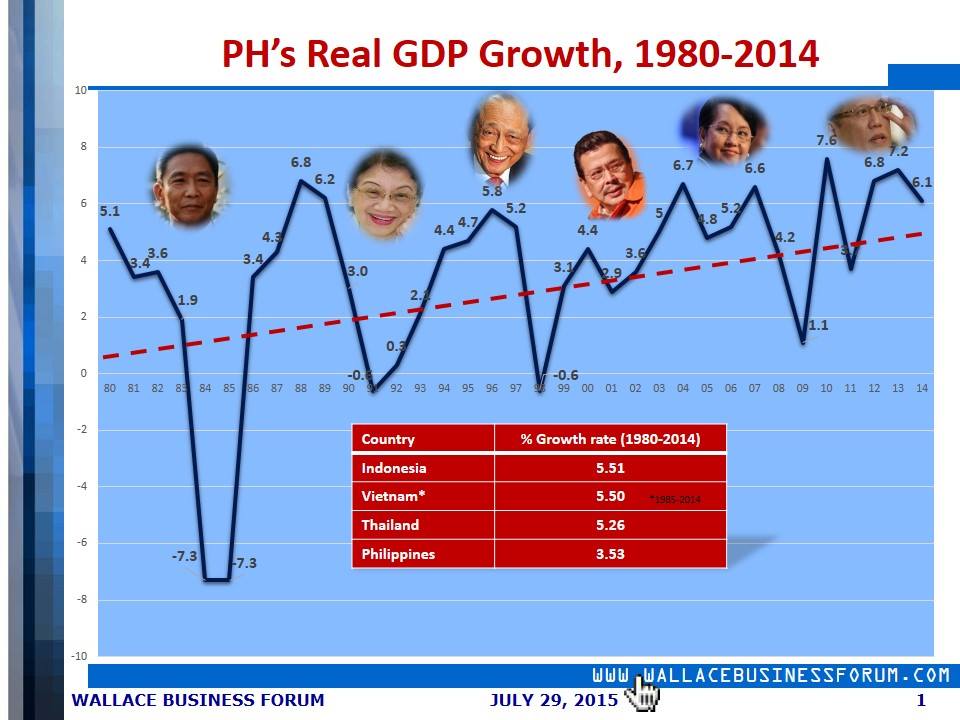
Despite the increase in FDIs, Vietnam has managed to overtake us as does the rest of ASEAN where FDI inflow is at a more rapid rate than Aquino’s ‘increase’. In truth, we are ranked 7th out of the 10 ASEAN members. GDP did grow in the early years of the Aquino administration, lulled by his assurances of The Straight Path, but by the time reality sank in, the growth slowed to 3.53%. The next rank above us, Thailand, is a distant 5.26%. We are doing worse than a country under Martial Law! (Wallace Business Forum).


As for inclusive growth, the dearth of FDIs and employment resulted in the top 5% oligarchy experiencing more growth from the lack of competition than the other 95% of the population, 53% of whom consider themselves poor in the Second Quarter of 2015, as per the Social Weather Station.   

MRT 3.

Said to be the most damning proof of the incompetence of the Aquino administration, being witnessed by millions taking the MRT daily, Aquino gives both barrels, firing one off at the previous administration for supposedly initiating the decay, and the other delivering the script provided to him by Department of Transportation and Communication (and Liberal Party acting President) Emilio Abaya, Jr. blaming the private owners of the system, MRT Holdings. Aquino claimed that MRTH entreated the DOTC to take over the maintenance of a deteriorating service. But the truth is that the two government banks, Land Bank of the Philippines and Development Bank of the Philippines, having controlling economic interest, ordered MRTH to turn over the MRT’s maintenance to DOTC, then under Aquino’s anointed one, Mar Roxas.

In short order, Roxas decided not to renew the contract of the regular maintenance provider Sumitomo Corporation (although they had been doing so for four times previously). Enter Jun Abaya who did not bother to have a regular bidding for a new contractor, but instead declared an ‘emergency procurement’ to justify his hiring PH Trams, a company less than a year old and undercapitalized headed by relatives of Liberal Party functionaries and a campaign manager of the Liberal Party. PH Trams was later replaced by APT Global, really PH Trams’ parent company.

So where did the deterioration begin? Sumitomo surrendered 72 working coaches and one inoperative coach to the DOTC when they took over in 2010. Today less than 10 coaches remain running. Despite a P57 million a month budget, no spare parts or rails were ever purchased by the DOTC, something Sumitomo had no problem with. Aquino claimed that the private owners neglected to perform maintenance in 2008 as required, but the MRTH presented records proving that maintenance was indeed carried out. By contrast, the DOTC has been unable to present a maintenance log since they took over, except for one covering a few months which they presented to a team of inspectors from the Hong Kong Mass Transit Railways visiting the country after the DOTC was pressured into allowing the inspections in the wake of a train which crashed through a concrete barrier in August of 2014. (The Hong Kong team was luckier than the MRTH, whose technical auditors were barred by the DOTC from inspecting critical systems.) It came as no surprise, then, that 2014 saw a four year high of MRT delayed trips.

The last straw in this barrage of hypocrisy surrounding the MRT was the way Aquino - who likes to harp about the ‘sins’ of the Arroyo administration - conveniently forgot another attack he made in his first SONA in 2011 where he castigated GMA for ordering the two government banks to buy out the MRT from the private owners. With his selctive memory, Aquino himself ordered Abaya to make the very same buyout. We already have a glaring example of how government manages (or mismanages) the maintenance of the MRT. It boggles the mind to imagine them fully in control.

Anything else?

The list of contradictions goes on and on, like the promised rice sufficiency contrasted by a Vietnamese dignitary jokingly requesting that we not buy so much rice from his country. The claim that the needs of the Haiyan/Yolanda survivors had been addressed, only to be questioned by the United Nations. (130,000 still living in tents and P170 Billion in relief funds still untapped). Even his very first claim in this SONA of no more wang-wang which symbolized the sense of entitlement which the powerful and connected of this country assume like a mantle knowing that their abuses will escape punishment is a hollow mockery set against our being the front-runner out of 59 countries with the worst impunity, beating even Mexico with all its drug cartel wars, making us worst in terms of structure of the security system of human rights.
                      (Impunity Index from the Impunity and Justice Research Center Unibersidad de las Americas in Mexico)

But the point is made. Aquino’s adeptness at Doublespeak is unmatched, turning the unpalatable into great leaps forward by the simple expedient of carefully editing his pronouncements.

But the neglect lays also in what he did not include in his SONA. There is, of course, the 44 policemen of the Special Action Force that perished in an operational SNAFU not unlike the Gallipoli disaster of the First World War, an operation Aquino was in on from the start, waiting in the wings to step forward once their target was captured. Also missing is the failure to have a Freedom of Information Act (thus our rank of 141 out of 180 in the Press Freedom Index of Reporters Without Borders).

But there are more significant, if less dramatic, omissions. Foremost of these is the failure to amend the economic provisions of the Constitution, specifically the 60/40 foreign equity law, a throwback to the xenophobic 50s and 60s and further resurrected by the Communists that Cory Aquino released after EDSA I (thus ensuring that even true Communists like Vietnam and China overtake us). One despairs at Noynoy Aquino ever having the wherewithal to tamper with a Constitution nurtured by his own mother. So add this to the deplorable infrastructure, exorbitant electricity prices, punitive taxation, a frozen mining industry, and finally runaway graft corruption and crony capitalism (of which the Philippines is in 6th place worldwide according to The Economist’s Crony Capitalism Index), and we have a virulently toxic investment climate.

Troll Season.

Ever since the State of the Nation Address was delivered, pro-Aquino forces have intensified their efforts on social media. Whether they are paid hacks of Malacanang or just blind loyalists is academic. In a way, though, their efforts are often pitiful, like watching a loathsome person in pain. This is because beyond merely doing a copy/paste of the Palace’s press releases or the zombie-like ejaculations of ‘Noynoy is the best President!’, they present little in the way of counter arguments. At the most they make vague claims with no supporting data, like ‘how can you accuse PNoy of being sympathetic to the leftist militants when so many Communist fighters have been killed?' Ask for data, and there is silence.

Trolls tend to make their attacks personal and infantile instead, as seen in these typical non-sequiturs they like to spout:

1. If you know so much why don’t you be President?
2. That’s why our country never progresses. It’s people like you who do nothing but complain.
3. Aquino has done so much. What have you done?

Such predictability is easy to address, aside from saying: 'What kind of a dumb question is that?'

What have we done? We obey the law, we pay our taxes, we educate our children. What more do you want? We do what is expected of us. Can the same be said about Aquino? And as taxpayers we have the right to complain of the shoddy service we're paying for. We complain because we are powerless against an administration that thinks only of protecting its political allies. That’s all we can do. 

The phrase ‘What are we in power for? is usually associated with contemptuous and corrupt authority figures to justify their entitlement to self-enrichment. But the same question can also be asked in a benevolent vein. Moreover, it can be applied to the President. Yes, we know what must be done, but we’re not the President. Noynoy Aquino is the President. He could easily dismiss corrupt individuals and initiate urgent long-term projects instead of looking for instant gratification through populist approval points. He could take the advice of expert technocrats and not the bureaucrats who are his cronies. He should ask himself: What am I in power for? For my Party? Or for my Country?

Quo vadis, Noynoy?

The Aquino administration has been riddled with decisions based more on populist politics rather than actual national progress. Thus his decisions (or indecisions) are often grounded on what he believes will bring him the most public approval in the shortest time, as in 'within his term' to arrest his sagging popularity. Witness the government's MWSS blithely violating their contract with private water concessionaires when the latter wanted to implement their scheduled rate increase, even though this would impact not only on service quality, but on investor confidence. Aquino's move to freeze all new mining contracts was in response to the strident calls of pseudo-environmentalists looking for political capital. Worst of all is his lack of interest in amending the restrictive foreign ownership provision in the Constitution, thanks to the efforts of the anti-capitalist, anti-foreign militants.

True, he is stepping down, but he still needs to buttress his endorsement power for Mar Roxas, his designated successor, and so the battle for hearts and minds continues.

Aquino's need for public approval even manifests itself by his pandering to the masses with pop culture references in his last SONA. Whether he realizes it or not, his utterance of Eh, di, wow directed at his critics is one to express total detachment and ineffectuality over serious matters, and only reinforces his image of being a buffoon.

(Alfred E. Neuman, mascot of MAD Magazine)
It is still a matter of conjecture whether Aquino is consciously corrupt, or is merely a babe in the woods allowing himself to be led by the nose by opportunists who convince him that any advice they give him is for the good of the nation. Is he, in fact, a product of Doublethink where he actually believes the deceptive statements he delivers?

It is time he took a stand and became his own man. Aquino came to power despite an unqualified background, but he is there, so we have to deal with it. More accurately, he has to deal with it, because only he has the means to do so. He must overcome his reliance on his cronies who are undoubtedly a crutch to his insecurity, holding his trembling hand. Instead he must start to listen to the real experts: Businessmen, technocrats, political scientists. Anyone looking at his present cabinet of bureaucrats, hacks political hatchetmen and women will immediately see an absence of these qualifications. (Ironically, this had been his mother’s failing as well, again, due to inexperience.)

There had been some been some bitter laughter when Aquino proclaimed us to be the ‘the Darling of Asia’ last May, because no one could recall anyone outside of Malacanang ever bestowing that title upon us. There is less than a year left to his term, far too late to make many changes. But Aquino can still leave a legacy that is truly his own and not that of his cronies. Rather than trying to look good at the present, he must initiate reforms for long-term benefits lasting well past his or even the next administration.

He can start by firing that incompetent and corrupt DOTC Secretary and returning maintenance of the MRT to the private owners who had managed it successfully. Then he must open up the economy and take advice from the right people. Two changes he can make before he steps down. Once he gets that ball rolling, eventually we can be a true Darling and Tiger of Asia.