Sunday, September 13, 2015

YOU CAN PUT THE BLAME ON ME

When I visited my brother Bob who is living in the US, he and his wife invited me out to dinner. At the end of the meal Bob pointed at the restaurant's rear area and said: “The washroom is over there.” Without a word, I took a folded piece of paper out of my pocket and handed it to him. On it I had written: Bob is going to tell me where the washroom is after the meal.

This was no mind-reading stunt. Bob tells me the same thing after every meal, apparently fearing I lack the mental capacity to remember to wash my hands after a meal, thereby sullying his car, furniture, etc. My point was to show how predictable he had become.

Predictability can be comical among friends and family members. But when it is exhibited among world leaders, it becomes pathetic.

From the moment Benigno S. Aquino III assumed the office of the Presidency, if there is one thing he has been consistent about, it is attributing any of the nation’s deficiencies to his predecessor, Gloria Macapagal Arroyo. This he does in everything from his yearly State of the Nation Addresses to press statements.

Personally, I do not care one way or another about GMA. Aside from the time she visited the call center where I worked to showcase how she (and not Mar Roxas) attracted BPO investments, none of her accomplishments (or alleged crimes) stand out in my memory. But whatever failures she must have had as a President, it is simply in poor form for Aquino to continually refer to them like clockwork. Anyone with a modicum of propriety - indeed, of maturity - would know that if they see a problem, even one caused by particular individuals, they should devote their energies to fixing the problem, while silently calling the person aside to get their side and, if necessary, mete out the proper action. The identity of the perpetrator is not germane to the issue. In Noynoy’s case, he is far from silent as to who he thinks is responsible.

My question is simple: Why does he have to do this at all?

Is he trying to elicit sympathy? 'Look at this unholy mess I have to clean up. It’s a massive undertaking. You should be satisfied with any improvements I make.’

If so, then all I see is an effort at prepparing his audience for the inevitable failure of his efforts. (I am reminded of how I would explain my poor grades with the plea: Everybody else got a low grade. But I was in high-school, for heaven's sake.)

It wouldn’t be so bad if Aquino actually did better than Arroyo. Yet whenever citizens’ complaints reach critical proportions, Aquino first blames GMA, then proceeds to screw things up even further. The worst display of this is the Metro Rail Transit issue. After an MRT train jumped the rails and crashed through a concrete barrier in August of 2014, public outrage prompted an investigation of the rail system. Numerous defects were discovered, like cracked rails, outmoded signal and electrical systems frequently breaking down, not to mention escalators and ticket machines that were no longer functioning. The Palace was quick to criticize the GMA administration for this, but the plain truth is that the MRT functioned effectively with only minor interruptions during Arroyo’s term and even the ones before that. The rot began only after the Aquino administration had the Department of Transportation and Communications (headed by the Acting President of the Liberal Party Emilio Abaya) remove in 2010 the regular maintenance provider assigned by the private owners to replace it with a company only two months old with no rail experience and grossly undercapitalized – which happened to be run by a campaign manager for the Liberal Party. Since then, no major repairs had been made, and no spares had been purchased. The private owners were even barred from inspecting critical systems.  Even with these revelations, Aquino continued to bluster, saying it was GMA and the private owners of the MRT to blame.

Recently, Aquino again laid the onus of the daily Metro Manila gridlock on Arroyo’s supposed neglect of the MRT. Yet, this still begs the question: What steps did Aquino take to ease traffic when he assumed office? It’s not like the traffic suddenly materialized with the breakdown of the MRT. It has been a chronic problem for generations. Oh, but I signed 20 Public Private Partnership road projects, Aquino crows. So why is traffic still bad? Because of those 20 PPPs, most have not even been put up for bidding, and those that have are bogged down from red tape like right-of-way issues. The NLEX-SLEX Connector Road was supposed to shorten travel time between Buendia and Balintawak to 20 minutes. The project timeline reads like a textbook case of bureaucracy. Ready to go since 2012, one red tape roadblock after another was thrown up, and after all that had been hurdled Aquino, in his function as NEDA Chairman, signed it February of 2015 only after Senate President Franklin Drilon complained how his trip to Baguio had taken 11 hours, thereby proving that all it needed was the moribund Aquino's signature. Worse, because of the delay, the project has to be redesigned, entailing not only additional expense but another slew of bureaucratic foot-dragging by the DOTC's Toll Regulatory Board sitting on approvals. This same leaden pace also plagues other projects like the SCTEX, NAIAX and CALAX. On the whole, out of 20 PPP infrastructure projects signed by Aquino, after five years only one, the Muntinlupa-Cavite Expressway, has been completed.


But the cherry on top of this serving of blame passing came during the recent conference of APEC finance ministers in Cebu. When Aquino stood before this crowd of highly-educated, well-informed international experts, what do you think he did? Three guesses, and two of them don’t count. He blamed Gloria Macapagal Arroyo:

Every day, it seemed, we uncovered issues that had festered during my predecessor's term. At that point, many of us could not help but long for the weekend, if only for a temporary respite from the problems bequeathed to us.

As to what those festering issues were, he enumerated them by way of patting himself on the back:

We relentlessly pursued all those who had committed wrongdoing, regardless of their wealth or influence; we revamped our budgeting system and exercised fiscal prudence, making sure that taxpayer money is spent prudently, conscientiously, and judiciously on projects and programs that truly benefit our people; we cut red tape and made it easier for investors to bet on the Filipino people.

This must have been salt in the wounds of a citizenry who has yet to witness the prosecution of a party ally; who are staggering under deficient infrastructure and social services by a government faulted with underspending by its own Department of Budget and Management; who are still wondering what happened to the other 19 PPP projects, and from red tape that has the World Bank placing the Philippines in rank 161 out of 181 countries surveyed in the category of Ease of Doing Business.

While the citizenry must have rankled, I shudder to think what those informed ministers felt. Was there a collective mental facepalm? Did they ask: How stupid does this guy think we are? Did they also write predictions on slips of paper? Did they take bets in the washroom that Aquino would blame his predecessor? Who needs Polish jokes and blonde jokes when our President is the laughingstock of the international community? Did he think he could bamboozle them as he had his less-critical local audience? 

With election season approaching, we must ask ourselves: Do we want six more years of this brand of Daang Matuwid.

Tuesday, August 4, 2015

WHAT ARE WE IN POWER FOR?


The term Doublespeak was inspired by George Orwell’s dystopian novel Nineteen Eighty-Four. Though the word itself does not appear in the novel, it evolved as a hybrid of the book’s Doublethink, or to tell deliberate lies while genuinely believing in them, and Newspeak, the new language designed to not only put emphasis on the positive, but to remove all shades in between extremes, thus, while the concept of bad may still exist, the word itself has been replaced with 'ungood', to establish the dominance of good. 

Doublespeak, therefore, is the propagation of Doublethink by use of Newspeak.

(From The World of Doublespeak by William D. Lutz)

In my youth I had difficulty grasping the concept expressed in the novel. But under the harsh reality of later adult life, I began to learn. Yet no experience was as illustrative of Doublespeak as the example yesterday afternoon, during the final State of the Nation Address of President Benigno Simeon Aquino III.

Not three minutes into his speech Aquino began with his usual staple of bashing the previous administration of Gloria Macapagal Arroyo, analogous to Orwell’s Two Minutes Hate, right down to the splashing on the wide screen the images of disgraced officials from the GMA period, a reminder of Aquino’s forte of trial by media, complete with screenshots of news items and statistics damaging to that administration. Emphasizing the fault of another in order to mitigate one's own shortcomings is Basic Doublespeak.

(Images from Nineteen Eighty-Four byUmbrella-Rosenblum Films

One should not put it against Aquino for trumpeting the supposed gains of his administration. After all, by its very name, this was to be an address of what state the nation was currently in. The cynicism came with the actual claims made in the speech.

Public Private Partnership.

Aquino’s first boast in our ‘journey along the Straight Path’ was the opening of the Muntinlupa-Cavite Expressway (MCX):

"...this is the first Public-Private Partnership project that we approved, and the first such PPP project opened to the public under our administration (English translation)."

There is no disputing the statement. But what Aquino fails to mention is that the MCX had been unnecessarily delayed for a year due to lack of oversight when right-of-way issues arose. The truth is out of the 50 PPP projects in his administration, at this late date, 27 are in the queue, 13 are still in the bidding stage, 10 have already been awarded but are delayed over different issues like Right-Of-Way, leaving a grand total of completed projects of . . . one. Since 2010 the Muntinlupa-Cavite Expressway is the first and only PPP completed, an accomplishment rate of 2% on Noynoy’s PPP record. Out of the 136 kilometers of new roads the DPWH says we need to ease our traffic holocaust, the MCX accounts for four kilometers. Granting one month of toll-free access cannot compensate for five years of sloth and inefficiency.

To add to the surreal atmosphere, Aquino compared the slow pace of PPP projects to the time it takes to deliver a computer. Unlike an order for a computer, the shipper does not sit on contracts like Aquino did as NEDA head where he ignored the approval of the NLEX-SLEX connector road since 2013, signing it only on February of this year after Liberal Party Ally Senate President Franklin Drilon complained about getting stuck in an expressway gridlock. 

To aggravate the situation vital projects like the Metro Manila Integrated Rail Terminal (a.k.a. Common Station) had been suspended for no other reason other than they were initiated by the hated Arroyo regime.

The K - 12 Program

When Aquino proceeded to attack his predecessor’s neglect of the country’s education, especially on classroom lack, it was predictable that he would lead to his K-12 Program, the new education curriculum that would add two years of Senior High School to the current four of Junior High to improve our standard of education.

As with most of this administration’s projects, it was a brilliant concept on paper but too little thought was devoted to obstacles that may occur, obstacles that, in fact, have been common knowledge for generations. Rushed into implementation, the promising program still faced a lack of classrooms (113,000 needed at the end of 2014), as well as a shortage of teachers, deficient teacher training, and defective educational aids like textbooks, among others.

Case in point is the Commission on Audit’s report that ‘due to lapses in oversight’ (again), the Department of Education wasted P608M in books meant for the old curriculum but are now obsolete because they were delivered just before implementation of K – 12.  

It was a case of good grain being sown on poor ground. But there is no glory in long-term remediation of a country’s ills like more classrooms and better-paid and better-trained teachers. No, what this audience needed was something flashy and spanking-new: The (fanfare plays) K – 12 Program.

This salute to the K - 12 program was capped by a 19-year old lady presenting her recorded testimonial of the new curriculum and ending with the words:

I'm proud that I'm a K to 12 graduate because I can now support my family. And I'm learning while I'm earning.

This was met with thunderous applause, of course. But it was hard to miss the collective confusion on some faces. How is it possible to graduate from a program that started only this year?


Economic Growth.

There was no let-up in the Arroyo-bashing:

Our predecessor took pride in "uninterrupted growth" during her last SONA. Scrutinize what she said, however, and you would realize that a significant portion of this growth was fueled by remittances from Filipinos who had lost hope in our country. As they say: People were voting with their feet. If I were to imitate that style of governance, I would be loath to claim a success borne of forcing my countrymen to escape our shores.

So how does Aquino stack up against his nemesis? He laid claim to an increase in jobs generated. Yes, indeed, there was an increase of 593,000 jobs – part time jobs. Full-time jobs fell by 130,000. Of the jobs that claimed to have increased by 1.2 million in 2014, 90% of that was informal employment.

It would be unthinkable for Aquino to acknowledge the efforts of our Overseas Franchise Workers, having derided their contribution to the economy earlier. But the truth is overseas deployment overtook local job generation. It is the OFWs plus the workers in volatile industries like tourism, BPOs and construction that are keeping this country’s head above the water.

Aquino’s counter to GMA’s ‘uninterrupted growth’ was his ‘inclusive growth’, thus, in a demonstration of the use of the non-sequitur, he rattled off a list of accomplishments like our improved credit rating, GDP growth and increase in Foreign Direct Investments, and even - I am not making this up - growth stemming from the imprisonment of three opposition senators. As before, none could dispute his data . . . and as before, he wasn't telling us the full story.

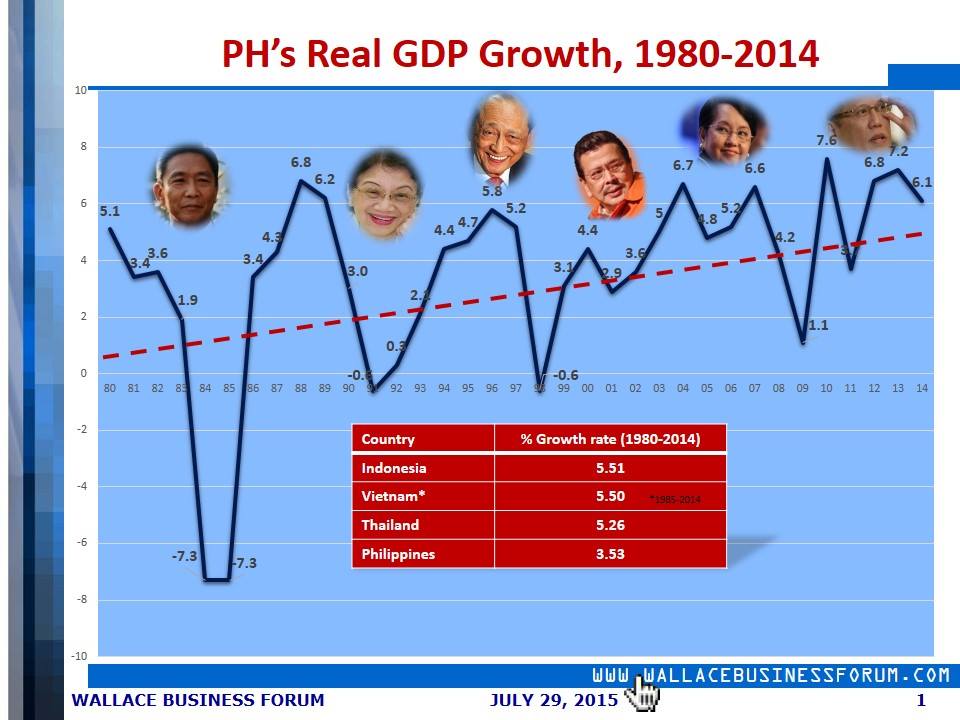
Despite the increase in FDIs, Vietnam has managed to overtake us as does the rest of ASEAN where FDI inflow is at a more rapid rate than Aquino’s ‘increase’. In truth, we are ranked 7th out of the 10 ASEAN members. GDP did grow in the early years of the Aquino administration, lulled by his assurances of The Straight Path, but by the time reality sank in, the growth slowed to 3.53%. The next rank above us, Thailand, is a distant 5.26%. We are doing worse than a country under Martial Law! (Wallace Business Forum).


As for inclusive growth, the dearth of FDIs and employment resulted in the top 5% oligarchy experiencing more growth from the lack of competition than the other 95% of the population, 53% of whom consider themselves poor in the Second Quarter of 2015, as per the Social Weather Station.   

MRT 3.

Said to be the most damning proof of the incompetence of the Aquino administration, being witnessed by millions taking the MRT daily, Aquino gives both barrels, firing one off at the previous administration for supposedly initiating the decay, and the other delivering the script provided to him by Department of Transportation and Communication (and Liberal Party acting President) Emilio Abaya, Jr. blaming the private owners of the system, MRT Holdings. Aquino claimed that MRTH entreated the DOTC to take over the maintenance of a deteriorating service. But the truth is that the two government banks, Land Bank of the Philippines and Development Bank of the Philippines, having controlling economic interest, ordered MRTH to turn over the MRT’s maintenance to DOTC, then under Aquino’s anointed one, Mar Roxas.

In short order, Roxas decided not to renew the contract of the regular maintenance provider Sumitomo Corporation (although they had been doing so for four times previously). Enter Jun Abaya who did not bother to have a regular bidding for a new contractor, but instead declared an ‘emergency procurement’ to justify his hiring PH Trams, a company less than a year old and undercapitalized headed by relatives of Liberal Party functionaries and a campaign manager of the Liberal Party. PH Trams was later replaced by APT Global, really PH Trams’ parent company.

So where did the deterioration begin? Sumitomo surrendered 72 working coaches and one inoperative coach to the DOTC when they took over in 2010. Today less than 10 coaches remain running. Despite a P57 million a month budget, no spare parts or rails were ever purchased by the DOTC, something Sumitomo had no problem with. Aquino claimed that the private owners neglected to perform maintenance in 2008 as required, but the MRTH presented records proving that maintenance was indeed carried out. By contrast, the DOTC has been unable to present a maintenance log since they took over, except for one covering a few months which they presented to a team of inspectors from the Hong Kong Mass Transit Railways visiting the country after the DOTC was pressured into allowing the inspections in the wake of a train which crashed through a concrete barrier in August of 2014. (The Hong Kong team was luckier than the MRTH, whose technical auditors were barred by the DOTC from inspecting critical systems.) It came as no surprise, then, that 2014 saw a four year high of MRT delayed trips.

The last straw in this barrage of hypocrisy surrounding the MRT was the way Aquino - who likes to harp about the ‘sins’ of the Arroyo administration - conveniently forgot another attack he made in his first SONA in 2011 where he castigated GMA for ordering the two government banks to buy out the MRT from the private owners. With his selctive memory, Aquino himself ordered Abaya to make the very same buyout. We already have a glaring example of how government manages (or mismanages) the maintenance of the MRT. It boggles the mind to imagine them fully in control.

Anything else?

The list of contradictions goes on and on, like the promised rice sufficiency contrasted by a Vietnamese dignitary jokingly requesting that we not buy so much rice from his country. The claim that the needs of the Haiyan/Yolanda survivors had been addressed, only to be questioned by the United Nations. (130,000 still living in tents and P170 Billion in relief funds still untapped). Even his very first claim in this SONA of no more wang-wang which symbolized the sense of entitlement which the powerful and connected of this country assume like a mantle knowing that their abuses will escape punishment is a hollow mockery set against our being the front-runner out of 59 countries with the worst impunity, beating even Mexico with all its drug cartel wars, making us worst in terms of structure of the security system of human rights.
                      (Impunity Index from the Impunity and Justice Research Center Unibersidad de las Americas in Mexico)

But the point is made. Aquino’s adeptness at Doublespeak is unmatched, turning the unpalatable into great leaps forward by the simple expedient of carefully editing his pronouncements.

But the neglect lays also in what he did not include in his SONA. There is, of course, the 44 policemen of the Special Action Force that perished in an operational SNAFU not unlike the Gallipoli disaster of the First World War, an operation Aquino was in on from the start, waiting in the wings to step forward once their target was captured. Also missing is the failure to have a Freedom of Information Act (thus our rank of 141 out of 180 in the Press Freedom Index of Reporters Without Borders).

But there are more significant, if less dramatic, omissions. Foremost of these is the failure to amend the economic provisions of the Constitution, specifically the 60/40 foreign equity law, a throwback to the xenophobic 50s and 60s and further resurrected by the Communists that Cory Aquino released after EDSA I (thus ensuring that even true Communists like Vietnam and China overtake us). One despairs at Noynoy Aquino ever having the wherewithal to tamper with a Constitution nurtured by his own mother. So add this to the deplorable infrastructure, exorbitant electricity prices, punitive taxation, a frozen mining industry, and finally runaway graft corruption and crony capitalism (of which the Philippines is in 6th place worldwide according to The Economist’s Crony Capitalism Index), and we have a virulently toxic investment climate.

Troll Season.

Ever since the State of the Nation Address was delivered, pro-Aquino forces have intensified their efforts on social media. Whether they are paid hacks of Malacanang or just blind loyalists is academic. In a way, though, their efforts are often pitiful, like watching a loathsome person in pain. This is because beyond merely doing a copy/paste of the Palace’s press releases or the zombie-like ejaculations of ‘Noynoy is the best President!’, they present little in the way of counter arguments. At the most they make vague claims with no supporting data, like ‘how can you accuse PNoy of being sympathetic to the leftist militants when so many Communist fighters have been killed?' Ask for data, and there is silence.

Trolls tend to make their attacks personal and infantile instead, as seen in these typical non-sequiturs they like to spout:

1. If you know so much why don’t you be President?
2. That’s why our country never progresses. It’s people like you who do nothing but complain.
3. Aquino has done so much. What have you done?

Such predictability is easy to address, aside from saying: 'What kind of a dumb question is that?'

What have we done? We obey the law, we pay our taxes, we educate our children. What more do you want? We do what is expected of us. Can the same be said about Aquino? And as taxpayers we have the right to complain of the shoddy service we're paying for. We complain because we are powerless against an administration that thinks only of protecting its political allies. That’s all we can do. 

The phrase ‘What are we in power for? is usually associated with contemptuous and corrupt authority figures to justify their entitlement to self-enrichment. But the same question can also be asked in a benevolent vein. Moreover, it can be applied to the President. Yes, we know what must be done, but we’re not the President. Noynoy Aquino is the President. He could easily dismiss corrupt individuals and initiate urgent long-term projects instead of looking for instant gratification through populist approval points. He could take the advice of expert technocrats and not the bureaucrats who are his cronies. He should ask himself: What am I in power for? For my Party? Or for my Country?

Quo vadis, Noynoy?

The Aquino administration has been riddled with decisions based more on populist politics rather than actual national progress. Thus his decisions (or indecisions) are often grounded on what he believes will bring him the most public approval in the shortest time, as in 'within his term' to arrest his sagging popularity. Witness the government's MWSS blithely violating their contract with private water concessionaires when the latter wanted to implement their scheduled rate increase, even though this would impact not only on service quality, but on investor confidence. Aquino's move to freeze all new mining contracts was in response to the strident calls of pseudo-environmentalists looking for political capital. Worst of all is his lack of interest in amending the restrictive foreign ownership provision in the Constitution, thanks to the efforts of the anti-capitalist, anti-foreign militants.

True, he is stepping down, but he still needs to buttress his endorsement power for Mar Roxas, his designated successor, and so the battle for hearts and minds continues.

Aquino's need for public approval even manifests itself by his pandering to the masses with pop culture references in his last SONA. Whether he realizes it or not, his utterance of Eh, di, wow directed at his critics is one to express total detachment and ineffectuality over serious matters, and only reinforces his image of being a buffoon.

(Alfred E. Neuman, mascot of MAD Magazine)
It is still a matter of conjecture whether Aquino is consciously corrupt, or is merely a babe in the woods allowing himself to be led by the nose by opportunists who convince him that any advice they give him is for the good of the nation. Is he, in fact, a product of Doublethink where he actually believes the deceptive statements he delivers?

It is time he took a stand and became his own man. Aquino came to power despite an unqualified background, but he is there, so we have to deal with it. More accurately, he has to deal with it, because only he has the means to do so. He must overcome his reliance on his cronies who are undoubtedly a crutch to his insecurity, holding his trembling hand. Instead he must start to listen to the real experts: Businessmen, technocrats, political scientists. Anyone looking at his present cabinet of bureaucrats, hacks political hatchetmen and women will immediately see an absence of these qualifications. (Ironically, this had been his mother’s failing as well, again, due to inexperience.)

There had been some been some bitter laughter when Aquino proclaimed us to be the ‘the Darling of Asia’ last May, because no one could recall anyone outside of Malacanang ever bestowing that title upon us. There is less than a year left to his term, far too late to make many changes. But Aquino can still leave a legacy that is truly his own and not that of his cronies. Rather than trying to look good at the present, he must initiate reforms for long-term benefits lasting well past his or even the next administration.

He can start by firing that incompetent and corrupt DOTC Secretary and returning maintenance of the MRT to the private owners who had managed it successfully. Then he must open up the economy and take advice from the right people. Two changes he can make before he steps down. Once he gets that ball rolling, eventually we can be a true Darling and Tiger of Asia.


Wednesday, April 15, 2015

So You Think You Know American English?

If you work at a call center or are planning to, there is a chance you will be dealing with native English speakers like Americans. What you may not know is that our Philippine English is not always the same as American English. Some of the English words or phrases we use regularly may sound puzzling (or even funny) to Americans.

Read the short story below and see if you can find anything that may not sound right to Americans. This is NOT a grammar test, but a test of your familiarity with American English.

As I approached the local chapter of the Marvel Superheroes Fans Club, I began to have second thoughts. The building was constructed from unpainted hollow blocks and was just a little taller than me. But my editor had requested for an interview with the club president, so I went right in.

The tiny space was fitted with cheap plastic furnitures. Sitting behind a desk piled high with all kinds of stuffs was Leonard Chamberlain, club president.

“I have a good news for you,” he announced after greeting me. We have several old members dropping by later. You can interview them.”

He opened a small ref filled with different foods. “Can I get you anything?” he asked, removing a sandwich from the ref and popping it in his oven toaster.

If you have coffee or tea or juice, that would be great,” I said.

"Sorry, I don’t. How about a soft drink?”

I accepted the cola gratefully. Leonard’s relaxed, informal style put me at ease immediately. He talked with a slang and told the funniest green jokes.

After our snack, he invited me to go for a short walk. ‘I have to get rid of all these fats,” he laughed, patting his generous abdomen.
*     *     *

So how many words or phrases do you think Americans will find confusing? Three? Five? Seven? None? Believe it or not, there are thirteen English terms here that are familiar to Filipinos but not to Americans. Want to try looking again? Go ahead, we'll wait.

And here they are . . .

1. Fans Club: Whether the club is made of one or a million fans, Americans say fan club.

2.   Hollow Blocks: Americans say cinder blocks, not hollow blocks.

3. Request(ed) for: If request is used as a verb, we do not add for. PHILIPPINE VERSION: Customer requested for a refund. AMERICAN VERSION: Customer requested a refund. (On the other hand, if request is used as a noun, then for may be used: His request for a refund was approved.)

4. A good news: Whether it is one paragraph or an entire news bureau, Americans do not use the ‘a’: I have good news.

5.  Ref: When referring to a refrigerator, Americans say fridge. (To them, ‘ref’ is short for referee.)

6. Oven Toaster: Toaster Oven.

7. Soft drink: Notice that Leonard said he has no tea, juice or coffee, but he had cola. Coffee, tea and juice are soft drinks, as is any beverage without alcohol. What we call soft drinks Americans call soda.

8.  A slang: First off, Americans never put a before slang. Secondly, slang is NOT that broad accent we associate with Americans, especially from the East Coast. That is twang. But slang refers to well-known or recent idiomatic expressions, like calling a beginner a newbie is slang (or worse, noob if s/he is clueless. And clueless is another example of slang.)

9.  Green jokes: Americans say off-color jokes.

And finally, the most common example of Philippine English, pluralizing unnecessarily . . .

 10.  Furnitures: Just furniture.

 11.  Fats: When referring to bodily tissue or meat cuts, it is fat. (Fats is used in specialized cases like biochemistry.)

12.  Stuffs: Whether one item or an entire warehouse: stuff. (If used as a verb, Stuffs is sometimes used: He stuffs all that stuff into that cabinet.).

13.  Foods: Recently (mis)used by certain condominium visitors. Whether one sandwich or an entire buffet, it is always food. (Foods is sometimes used when referring to commodities or for commerce: Purefoods.)

So what lessons can be learned from all this? If your answer is

Now I know that I have to say cinder blocks and not hollow blocks,

Sorry, but that is only a tiny part of it. The whole point of this exercise is to show that there are so many examples of how the things we take for granted may be different elsewhere. 

There are many, many more examples other than these thirteen, so memorizing them is not enough, and learning the rules is too tedious.

The more important lesson is that with this revelation, we now must develop

active listening and active reading.

That means watching shows and reading material that use American English and then catching any differences from Pinoy English. So if a character or passage says: He ordered a dozen roses, an active listener/reader will right away notice: He said a dozen roses, not the usual a dozen of roses, and then commit that to memory.

Keep in mind that the reason many Filipinos say hollow blocks, green jokes, stuffs, etc. is because they hear other Filipinos use them and assume it is the norm. Their favorite argument is: That's how everybody says it. But 'everybody' is not limited to just the people around you. 'Everybody' says will gonna, but you won't hear a single American say that.

(Americans do have their own errors but they are different from ours. For example, some Americans say axe instead of ask, something we don't say.)  

Incidentally, active listening also works for correct pronunciation. For example, if an active listener hears the names Leonard or Chamberlain, s/he will notice that the first is pronounced LEH-nurd, not lee-O-nard, and the second is CHEYM-ber-lin, not cham-ber-LEYN.

********This is an original composition, but feel free to share******

Tuesday, April 14, 2015

Growth in Them Thar Hills


My first glimpse of a mine was, appropriately enough, from Mines View in Baguio City when I was a young teen. Having no interest in tacky souvenirs, I chose to spend my time on the observation deck while my family did their tourist shopping. (Me, I was saving my money for the used books on sale at the public market.)

As the cool breeze wafting over me heightened the idyllic mood that afternoon, I gazed idly upon the mining colony in the distance that gave the place its name, and I imagined I could hear the clink of pickaxes on rock. (I had not known at the time that I was looking at abandoned mines . . .)

As I turned to go I saw something that made me think I was hallucinating.  On the side of a large mound not far from the tourist shops was a hole that was large enough for me to walk through standing up. Odd: I didn’t think there were any mines that close. Stupid kid that I was, I went inside.

As I squelched in the mud (thereby effectively nullifying the shoeshine I had earlier) I advanced down a tunnel, all the while fantasizing that I was exploring some cave from my Dungeons & Dragons pencil and paper game. There was a faint light a few meters away and I made my way towards it until I heard voices. Still in my fantasy world, I edged closer to try to listen in on what they were saying without being spotted. . .

Unfortunately, they were speaking in the local dialect, so I decided it was time for me to head back. I wasn’t afraid of being captured by orcs and fed to trolls or even of a cave-in, but more of being hauled off to the precinct for trespassing.

That semi-adventure imbued in me some silly belief that I could tolerate, if not thrive in, a life under the earth. I often fantasized digging some unidentified ore from the cave walls and getting rich off it.

Aside from an occasional mention in our Social Studies class, mining didn’t enter my consciousness again until many years later when I was working for a call center. To establish rapport with my customer, I learned that he was into buying gold. He wanted to know what gold mining was like in the Philippines, and I said something about it being the domain of small miners.

Years later I ran into a former classmate from my Diplomate in Teaching class. She was to meet a fellow teacher who, it turns out, taught at the Philex Mines Elementary School in Padcal, Benguet. My mind returned to that day on the rugged hewn slopes of Mines View. I pictured a rough and ready pioneer schoolmarm with ropy arms and calloused hands amidst those slopes. When she finally showed up I had to conceal my surprise as I greeted her. (I apologize for not recalling her name.) She looked so delicate and tiny – sorry, petite – that a stiff breeze would have blown her away. I felt self-conscious as my classmate and I held our sandwiches while Teacher cut hers daintily with a knife, primly dabbing her lips at every bite.

My friend remarked how Teacher hadn’t changed since the last time they met more than three years ago. “Must be the mountain air,” I piped in, feeling all-knowing.

“But look at me,” my friend lamented. “I’m looking older than my age. The job is okay, but life in Metro Manila will wear anyone out.”

“How is it with you,” I asked Teacher, as my mind’s eye saw her scaling muddy crags and crossing rickety bamboo footbridges every morning to get to school.

As it turned out, Teacher made residence within the same Philex Mines compound. She showed me a small photo album (no Instagram then) of the employee’s residence, a two-storey concrete affair. As I thumbed through her album she pointed out the various features. In addition to the elementary school there was also the Philex St. Louis High School which has graduated more than 40,000 students since it began in the 70s. (Philex Elementary graduated more than 100,000 since the 60s.) Far from being ramshackle structures, they were not much different from the private school I attended in the city. She didn't have to travel very far for other needs, either, because the nearby Padcal community had everything residents needed.

I thought that was impressive enough until I remembered why my classmate was meeting Teacher. They needed to coordinate for Philex’s Adopt-a-School program. In addition to their own schools, Philex assists in the upkeep and rehabilitation of other schools in both host Padcal as well as neighboring communities.

Fast forward to the present. While doing research for the region where I was stationed I happened across the list of Human Development Index in the Philippines. HDI, to put it simply, is a measure of how well one’s needs are met as far as basic necessities go, or as the United Nations Development Programme puts it, is “a summary measure of average achievement in key dimensions of human development: a long and healthy life, being knowledgeable and have a decent standard of living.”

I expected Metro Manila to be at the top of the list but it wasn’t. The frontrunner, the region with the highest and most complete standard of living is – Benguet! (Data as of 2009/)

Seriously?! All that from strawberries and wooden figurines in barrels? No, it was from Mining. (The ‘perfect score’ for HDI is a 1. Benguet is 0.883 and Metro Manila was second at 0.837).

Here I learned about the so-called multiplier effect, which is basically the benefits that a business generates reaching the surrounding areas. Economist Bernardo Villegas a professor and senior vice-president at the University of Asia and the Pacific (UA&P), the Chairman of the Center for Research and Communication, a member of the Board of Trustees of the Makati Business Club, reveals that the benefits of mining to national development are not only from the minerals dug up, not even from tax revenues and export earnings. He points out that mining also means employment generation, which in turn fuels small and medium scale industries to cater to those wage earners’ consumption of goods and services. Mining communities like Philex typically have advanced educational, livelihood and medical facilities (Many of Teacher's pupils had been born in the Philex-run Sto. Nino private hospital in Padcal). Villegas compares mining to the outsourcing industry with links to other industries and even infrastructure, (Before Philex, there were no roads and no electricity going to those far-flung communities, Teacher had said.)

To express it in the simplest mathematical terms, said Villegas, for every P1 demanded of the mining industry, P2.60 goes into the national economy. That’s more than double and a half return of investment! Others like Canada, South Africa and even Malaysia have built their industry around mining. We can surely match that. If mining in this country is fully developed, we have a good chance of eradicating poverty and the damage done by this administration and others within this generation!

The mining industry is currently governed by the Mining Act of 1995 which covers all aspects of the industry from taxation to even environmental protection. (I remember one of Teacher’s photos which showed her and other Philex employees participating in their regular greening project. Not only did they perform tree-planting in mined-out areas, but they went so far as to plant in areas that never had trees.)

I was astounded to further learn that the Philippines has the second largest untapped gold deposits in the world. Our little archipelago with all that gold! (Philex mines in Padcal mines both gold and copper. Hardly the small outfit my uninformed mouth blurted out long ago.)

But now there is some tarnish in that golden future. In 2012 President Benigno Simeon Aquino, Jr, signed Executive Order 79 which in effect taxes mining twice. This scheme was the brainchild of the Mining Industry Coordinating Council created by Aquino based on the belief that the 2% excise tax of mining is too little. Despite the name, MICC is actually a multi-sectoral group which includes not only representatives of the mining industry, but also those from non-governmental organizations associated with militant mass action (read, leftists) and cabinet members who are more politicians than technocrats and who have no knowledge of mining.

Predictably, the bleeding-heart leftists played the environment card, and predictably, the populist Aquino administration whose hunger for brownie points is only matched by its lack of technical expertise, jumped at the chance. The environmentaleftists attacks are predicated on the centuries-old tactic that it’s easier to attack the law abiding miners who follow environmental laws (or even those who go one better, like Philex greening new areas) than it is to arrest illegal miners (no longer small-scale with their heavy equipment) who pay no taxes and ignore the environment and are protected by corrupt local officials. With all the energy they expend in protest actions, the radicals have not once spoken out against the illegal miners, their favorite targets being the registered mining companies like Philex, Atlas, Lepanto, etc.. C'mon, these self-styled environmentalists haven't even planted a single tree! Our government totally devoid of political will is only too willing to take this lazy way, too of penalizing the law-abiding..

Executive Order 79 or for that matter, any mining legislation under Aquino only spells disaster for the industry. He blindly believes the radicals' claims of environmental destruction at the expense of - get this - tourism. Tourism in a country riddled with corruption, rotten infrastructure and crime.  

Despite presentations of the industry representatives that the current Mining Act is on a par, if not better than comparable legislation worldwide in terms of environmental protection, community development, workers welfare and yes, taxation, their input was ignored by the politicians chairing the Council and the MICC plan railroaded through.

If there is anything wrong with the Mining Act of 1995, it is that like many Philippine laws, implementation is a joke, particularly in the prevention of illegal mining. And like other poorly-enforced laws, the kneejerk solution is to try to change it with a new law, which E.O. 79 threatens to do.

The plan, the miners say, will only result in taxing the industry to death. (It goes without saying that the illegal miners will remain unaffected.) But before that happens whatever benefits the multiplier effect distributed will wither away under the burden of punitive taxation. The mining industry is in a delicate balance as it is, requiring confidence in long-term investments in a market that could go either way at any time with the vagaries of world metal prices and currencies, among others. The last thing it needs is more taxes.

The leftists don’t really care about increased revenue or the multiplier effect. Taxing the industry to death is exactly what they had in mind. Their leftist dialectic demands the eradication of all private enterprise in favor of state control, which they will inevitably push for once private sector mining collapses. And there’s a good chance that they may get it.

Currently, there is an Aquino-initiated moratorium on all new mining. This and the impending catastrophe of EO 79 caused investors to shun Philippine mining.  The past few years have seen negative growth in the industry. Our vast, shining untapped wealth estimated at trillions of dollars remains hidden under the proverbial bushel.  And while Aquino likes to crow about the supposed increase in Foreign Direct Investments, he conveniently leaves out the part that our FDIs are still the lowest in all of Southeast Asia. Worse, a drop of 71% was noted this quarter.
  
It is the cruellest of ironies that one of the buzzwords of the Aquino administration was ‘inclusive growth’, yet the moratorium and his E.O. 79 threaten to strangle the multiplier effect.

The Chamber of Commerce of Canada has already warned against the passage of E.O. 79, which is now only awaiting Congress approval. It remains to be seen whether the Noynoy administration will finally be our economic Messiah and quash the EO or will it remain true to form as self-righteous Pharisees, blaming all but their own house.


Monday, March 23, 2015

NATIONALIZATION: THE ANSWER TO EVERYTHING FROM POVERTY TO DANDRUFF...


Word association test: Does the name Snyder-Gardner mean anything? If you’re an electrical engineer, it might. I am not, yet this name from my childhood resonates in my mind to this day. These were the names of power generating units, and the reason I recall the name so well is because they kept cropping up in newspapers on account of their constantly breaking down. (There was no cable TV or electronic games then, so I did a thing called 'reading'.) This little kid now had a name to which he could attach to the villain responsible for depriving him of his cartoons and physical comfort because of brownouts (another term I learned).

Fast forward to adulthood. I was fortunate to land a teaching job at a private tutorial center. Unlike the classrooms I had attended in college, ours were air-conditioned. That didn’t last long, however. Rotating brownouts, especially during the summer months when enrolment was at its peak, again became the norm, forcing us to open our windows to Manila traffic and trying to get our lessons across through the noise, heat, humidity and dim lighting. There was also a new set of names added to my brownout rogue’s gallery: Artemio Malicsi and Ernesto Aboitiz, both Presidents of the top villain, NAPOCOR or the National Power Corporation. No nightly news broadcast was complete without a video of Mr. Aboitiz standing before a projection screen (no Powerpoint back then) with his omnipresent steel pointer explaining the latest breakdown, to the point that many frustrated power consumers wanted to show him what to do with that pointer.

While the Meralco of my childhood had been run by Eugenio Lopez, Martial Law saw his hurried departure before he could replace all the superannuated equipment. (The Snyder-Gardners dated from the American administration.) The utility was taken over by government’s NAPOCOR. Flush with the victory over political opponents, the Marcos administration funnelled resources to its many cronies while neglecting long-term investment for the power generating sector. Whatever feeble stopgap measures NAPOCOR instituted was no match for the growing demand for electricity. Brownouts became longer and more frequent. 

After EDSA I Meralco, now a power distributor that purchased electricity from energy producers or generation companies (gencos), reverted to private ownership, first to the Lopez family and then to Manuel V. Pangilinan. To aid in his fastrack recovery of the tottering power sector President Fidel V. Ramos signed the Power Crisis Act of 1993. The Act had a bumpy beginning due to the Asian Financial Crisis of 1997, but the most notable feature was that now the power sector would be dominated by the private sector, from generation to distribution.

Let’s pause here for a moment…

This walk down memory lane only shows that we have not learned from our mistakes, but like the saying goes, we are doomed to repeat those mistakes. Despite the sins of the past, certain sectors, dismayed by rising costs, are calling once again for the nationalization of the public utilities. Not just the power sector but everything else: transportation, water, healthcare, etc.

I like to think that those people pushing for nationalization fall into two categories. First you have the average disgruntled citizen who is unfortunately guided by the simplistic black-and-white logic that if a certain system is unpopular, then scrap it for something entirely different. In the case of electricity, it’s well known that the Philippines has the most expensive electricity in the region, thus the kneejerk response: Privatization obviously is a failure. Let government run it.

The second group of people pushing for state-control do it because it is part of their agenda. I’m referring to the leftist organizations with their moribund 60s-era Communist ideology attempting to pit obsolete dialectic against historical inevitability. Their answer to every ill of society from anarchy to zero-sum economics is Nationalization. High electricity bills? Nationalize it. Poor water service? Nationalize. Trains not running on time? Let the state handle it.

Nationalization is a win-win situation for the leftists. If it works, well and good, we have a smoothly-running society and the leftists gain political capital. But if nationalization fails, then so much the better. When services degrade from government mismanagement, and enough people get angry, and government collapses, our Marxist Red Knight comes galloping to the rescue, moving into positions of power, with all vital industry and utilities all wrapped up in a neat state-controlled package a la North Korea. They are the ones stoking the anger of the aforementioned disgruntled consumers with their displays of militant outrage.

The militants have their work cut out for them; our national character has a built-in hostility towards those considered wealthy and successful. (It doesn’t help that our entertainment media never tires of the cliché of the vile, degenerate rich villain with no redeeming factor whatsoever.) Add to that our crab mentality and you have fertile ground for any anti-capitalism, anti-private sector propaganda. A casual glance at the negative comments on social media directed at privatized service invariably has the blanket condemnation of the rich-are-evil extraction. Period. No supporting statements are provided because as far as the naysayers are concerned, they hold this 'truth' to be self-evident. (Translation: Ah, basta!)

Those promoting state-control like to cite examples of successful nationalization like Singapore, Japan and so on. But one wonders why they cannot cite a Philippine example. I submit that it is because they cannot find a single case where nationalization in this country was successful. If we’re to make a game of citing examples from other countries, then how about Bangladesh’s rail system, or Indonesia’s water utilities, both state-run concerns with reportedly deplorable service?

To be fair, nationalization is not an ogre, per se. It may even work in the Philippines someday. But to institute it at this point thinking it will improve the situation is a cart-before-the –horse measure.

Nationalization has a better chance of success in a society where government possesses political will, with a bureaucracy free from excessive red tape, and most of all, with no more culture of impunity and political patronage. For us to transform ourselves into a society even slightly comparable to the aforementioned Singapore and Japan is a task for which even the description ‘Herculean’ is inadequate. This will involve a 180-degree turn in our national psyche, not to mention the passing of several generations before those changes become part of our national character. Currently, the Philippines is woefully inadequate in these qualities, thus the constant failure of state-control.

(Worse, corrupt politicians make a brisk business out of state-run services.) 

We need look no further than the Metro Rail Transit 3 system (MRT3) as a contemporary example of another public utility deteriorating under government control. While technically owned by Metro Rail Transit Holdings (MRTH), a consortium of private companies, the MRT had its maintenance responsibilities taken over by the government’s Department of Transportation and Communications (DOTC) in 2012 when they promptly relieved Sumitomo Corp., the maintenance provider hired by MRTH and replaced it with an undercapitalized and newly-formed company. Since then, the decline of the MRT has been unprecedented, culminating in a derailment in August of 2014. The malaise that the MRT is currently suffering can be attributed to those destructive aspects of our society previously mentioned. Political patronage has positioned the President of the ruling party in the DOTC seat despite a lack of a technical background. Impunity has paralyzed the investigation and prosecution of a DOTC official reported to have attempted to bribe a Czech contractor. Finally, total absence of political will has officials all the way up to Malacanang exhibiting appalling indifference for practical solutions, and instead imposing impractical and dilatory ‘solutions’. The Not Invented Here mindset (really a form of crab mentality) is present as they harbor hostility to unsolicited offers from the private sector to clean up their mess, preferring to hire their contractor of choice without bid, confident that no one will stop this blatant double-standard despite the fact that this was the very reason we were saddled by an incompetent contractor back in 2012.

One shudders at the thought of what the future holds if this same diseased government controls every industry and utility.

By contrast, the water utilities sector enjoyed the most successful Public-Private Partnership agreement in this country’s and ASEAN’s history. ‘Enjoyed’ because again, this populist government bent on garnering approval points reneged on the PPP contract which allowed regulated rate increases, an arrangement that had been working well for 17 years. The resulting lengthy arbitration and frozen rates could impact on quality of service.

Simply put, the private sector does very well, thank you very much, until government steps in and contaminates the whole proceeding.

To be sure, government does have a vital role in public utilities. They become necessary in aiding indigent or lower-income groups access to those services. But this only adds weight to the argument for privatization. Management and financing from the private sector of these services would free up government subsidies for use towards not only the poor but for other parts of the country that do not enjoy the same largesse Metro Manila has been getting.

The privatization of electricity and water came about precisely because of the failure of nationalization, and these resulted in the Electric Power Act of 1993 and the Water Crisis Act of 1994.

While brownouts are no longer as frequent as they were in pre-Crisis days, government’s own Department of Energy and the private sector foresaw the recurrence of another energy shortage as far back as 2010, given the lack of new power projects and the condition of aged generation units. Unfortunately, once again, our old demons of weak political will and outright incompetence return to plague us and threaten to bring back the Dark Ages. Regulatory bodies fail to regulate or prevent excessively high prices of electricity in the spot market. Government fails to prepare for maintenance shutdowns announced more than a year in advance. Decrepit power plants normally running on natural gas had to switch to more expensive diesel fuel while repairs were being made. Private sector attempts to set up new power projects are hamstrung for populist reasons and bureaucratic red tape. What new power plants there were had been similarly stymied. Case in  point is the coal-fired power plant in Subic that was prevented from operating in 2012 even before it could produce a single watt of electricity, due not so much to environmental concerns, but to a mere bureaucratic technicality.

With another power crisis looming, the Supreme Court in February of 2015 belatedly reversed the earlier decision and upheld the Subic plant’s permit to operate – three years after its suspension. While the plant is now allowed to open, it will take years for it to not only come fully online but to find investors to finance it, way too late to arrest the coming new crisis.

It is bad enough that we forget the lessons of the folly of government-run services, but it is even more ironic when one considers we are to this day still paying the debts not only for the emergency purchase without bidding of power generators as part of Ramos' fastrack measures, but also the ones incurred by NAPOCOR prior to his administration.

The main objection to the privatization of public services is the supposedly high cost to consumers. Public facilities run by private companies need to turn a profit, unlike a government-subsidized service. True enough, but given the choice between a subsidized service that continually breaks down (and in the case of the MRT, is potentially life-threatening) versus one that is costly but effective, the choice is clear. Quite simply, if the private sector doesn’t maintain good service, they don’t make a profit, thus it behooves them to maintain an acceptable level of efficiency. The private sector may be profit-driven, but a populist-driven government whose only motivation is instant gratification as against what is practical and enduring is more deleterious. Consider, too, the ‘hidden costs’ that come with poor infrastructure in the form of lost work hours, stress, medical bills and additional transportation (like to ferry water as I did in my childhood), and finally, diminished investor confidence. Once people learn to see the correlation, then the choice becomes easier: You get what you pay for.


It would be so wonderful to say: ‘Government can keep the prices low and fix the service.’ It’s always nice to have the best of both worlds, but at present this is not possible. Once we have the political will of Singapore and the sense of unity of Japan, when we have gotten our act together as a people and are able to elect competent leaders under a working system of checks and balances, then that goal is attainable.